
From Adair to Fitzgerald: The Western District of Pennsylvania’s Legacy Within the NCBJ: Part I
By: Hon. Jeffery A. Deller, Western District of Pennsylvania
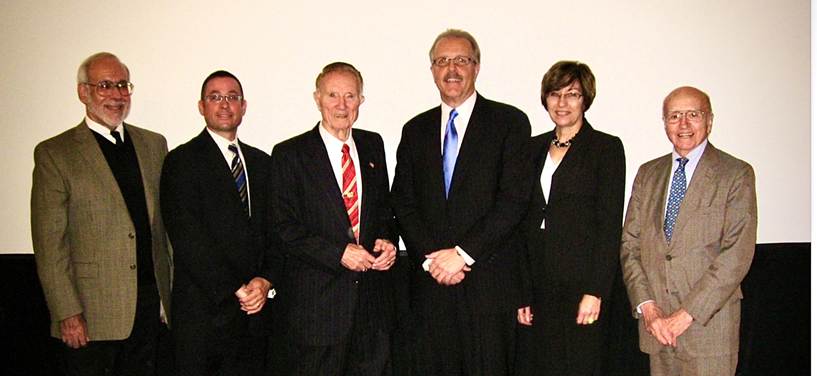
WDPA Bankruptcy Court judges circa 2006.
Left to right: Judge Bernard Markovitz, Judge Jeffery A. Deller, Judge Warren W. Bentz, Judge Thomas P. Agresti, Judge Judith K. Fitzgerald, and Judge Joseph L. Cosetti.
There are certain moments in life when one comes to understand that a profession is more than work and that a court is more than a building. For me, that realization developed gradually over many years through the influence of individuals whose lives and careers became deeply intertwined with the history of the bankruptcy judiciary itself. Their impact extended well beyond the cases they decided or the titles they held. It shaped the culture, character, and institutional identity of the bankruptcy system as we know it today.
Three figures stand above all others in my mind: Watson B. Adair, Joseph L. Cosetti, and Judith K. Fitzgerald. They served in different generations, possessed very different personalities, and confronted distinct challenges, yet together they tell an important story about the growth and evolution of both the bankruptcy judiciary and the National Conference of Bankruptcy Judges (“NCBJ”). Their story is also deeply personal to me because, in different ways, each shaped my understanding of what judicial service is meant to be.
I never met Watson B. Adair. He belonged to another era entirely, one far removed from the modern bankruptcy court system. Yet I have spent my judicial career living within the institutional world he helped create, and I have often reflected upon the extraordinary legacy left behind by his generation.
Adair served during a formative period in American bankruptcy history, when bankruptcy referees were still struggling to define both their authority and institutional identity within the federal judicial system. Referees frequently operated in relative isolation, with procedures differing substantially from district to district and little sense of national cohesion. Many maintained private offices and functioned more like localized administrators than members of a nationally organized judiciary. Adair recognized the danger inherent in that fragmentation. He understood that bankruptcy adjudicators could not effectively administer an increasingly national economy if each district operated as an island unto itself. The bankruptcy system required communication, professional identity, educational exchange, institutional legitimacy, and a shared commitment to improving the administration of justice.
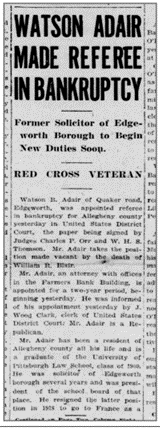
Watson B. Adair appointed Referee in Bankruptcy (1920).
In 1926, referees from across the country gathered in Detroit to organize the National Association of Referees in Bankruptcy, the organization that would ultimately evolve into today’s National Conference of Bankruptcy Judges. Only one year later, in 1927, Watson B. Adair of Pittsburgh became President of that Association. His election is historically significant because it places him among the architects of the modern national bankruptcy judiciary during its earliest formative years. He was not merely participating in an already established organization; he belonged to the generation responsible for building it from the ground up at a time when the very idea of a nationally coordinated bankruptcy judiciary remained relatively novel.
The National Association of Referees in Bankruptcy embodied a remarkably forward-looking vision for its era: the belief that bankruptcy adjudicators should function as members of a national professional community dedicated to education, collegiality, judicial improvement, and public confidence in the administration of insolvency law.
Adair’s importance to the bankruptcy system did not end with his presidency. Far from it, he remained active within the national bankruptcy community for decades and belonged to the generation of referees who guided the bankruptcy system through one of the most consequential reform periods in American legal history. His influence extended well beyond Pittsburgh and far beyond any single leadership title.
That broader reform movement reached its fullest expression with enactment of the Chandler Act of 1938. In Debt’s Dominion: A History of Bankruptcy Law in America, Professor David Skeel describes Referee Watson B. Adair as playing a remarkably influential role in the legislative process culminating in the Chandler Act. Skeel portrays Adair not merely as a commentator on the legislation, but as one of the bankruptcy professionals who effectively operated as a working extension of the House Judiciary Committee during the drafting and hearing process.
As Skeel explains, bankruptcy professionals in the 1930s wielded extraordinary influence because of the technical complexity of insolvency law and Congress’s reliance upon subject-matter experts to draft and explain proposed legislation. During the House hearings on the Chandler Bill in 1937, Representative Walter Chandler invited members of the National Bankruptcy Conference to present and explain provisions of the proposed legislation. Watson Adair, by then a nationally respected referee from Pittsburgh and a prominent figure within the National Bankruptcy Conference, was specifically tasked with explaining portions of the bill’s definitional provisions.
Skeel further observed that members of the National Bankruptcy Conference “functioned not merely as witnesses, but as de facto members of the House Judiciary Committee for the purposes of the Chandler bill hearings.” In that context, Adair’s role extended far beyond ordinary testimony. Bankruptcy professionals such as Adair left “their fingerprints on almost every other step of the process,” including proposing legislative language, explaining technical provisions, and shaping the final contours of the statute itself.
Adair belonged to the generation responsible not only for shaping those reforms, but also for implementing and legitimizing them nationwide. Through the National Association of Referees in Bankruptcy, referees such as Adair fostered national dialogue, strengthened professional standards, encouraged legislative modernization, and enhanced public confidence in the bankruptcy process itself. The Association became an institutional force that helped transform bankruptcy adjudication from a fragmented local function into a coherent national judiciary.
The practical significance of those reforms soon became evident in the increasingly complex reorganizations confronting the federal bankruptcy system. Few proceedings better illustrated both the expanding role of bankruptcy referees and the growing sophistication of American reorganization jurisprudence than the insolvency of Pittsburgh Railways. Adair’s appointment as Special Master in those proceedings placed him at the center of one of the most consequential transportation reorganizations of the Depression and New Deal era.
Pittsburgh Railways was not merely a local trolley operator. It was the sprawling transportation backbone of industrial Western Pennsylvania: a vast network of interlocking streetcar, interurban, and traction companies carrying workers through the mills, factories, river valleys, and steep hillsides of the Steel City.
The significance of Adair’s role becomes even clearer when viewed against the broader importance of the Chandler Act. The Act represented the most sweeping reform of American bankruptcy law since the Bankruptcy Act of 1898. It modernized corporate reorganizations, strengthened debtor rehabilitation provisions, expanded wage-earner relief, enhanced fiduciary oversight, and significantly elevated both the authority and stature of bankruptcy referees themselves. What had once been viewed primarily as a localized administrative process increasingly became a coordinated and respected federal judicial system.
Organized in 1902 through the consolidation of dozens of independent trolley systems, Pittsburgh Railways reflected the technological and industrial revolution that transformed urban America at the turn of the twentieth century. Its growth was deeply intertwined with the industrial empire of George Westinghouse and the Philadelphia Company, Westinghouse’s powerful corporate vehicle for natural gas, electric power, and transit-related investments. The Philadelphia Company supplied the financial and corporate infrastructure necessary to assemble Pittsburgh Railways into an integrated regional transportation network, while Westinghouse’s pioneering work in alternating current electricity and electric traction technology provided much of the infrastructure that made large-scale electric transit possible.
In many respects, Pittsburgh Railways represented the convergence of finance, electrification, engineering, and industrial ambition that defined Pittsburgh’s emergence as one of the great industrial capitals of the modern world.
Yet the system’s complexity extended far beyond operational difficulties. Beneath the parent corporation existed dozens of affiliated subsidiary corporations — the so-called “underliers” — that technically maintained separate corporate identities while functioning economically as a unified transportation enterprise. The resulting litigation became an important precursor to the modern doctrine of substantive consolidation. Creditors and tort claimants argued that the underliers could not shield themselves behind formal corporate separateness when the enterprise functioned operationally, financially, and publicly as a single transportation system.
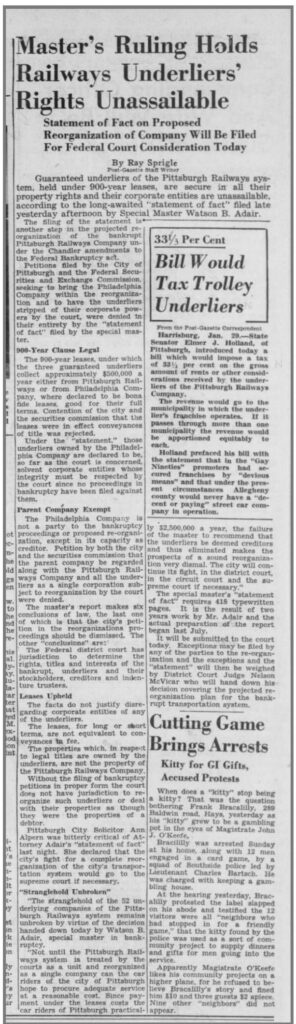
Pittsburgh Railways litigation involving Watson B. Adair.
By the late 1930s, however, the immense system had become financially unsustainable. Declining ridership, mounting liabilities, changing transportation patterns, and the crushing burdens associated with maintaining such an expansive transit network during the Great Depression forced Pittsburgh Railways into reorganization proceedings.
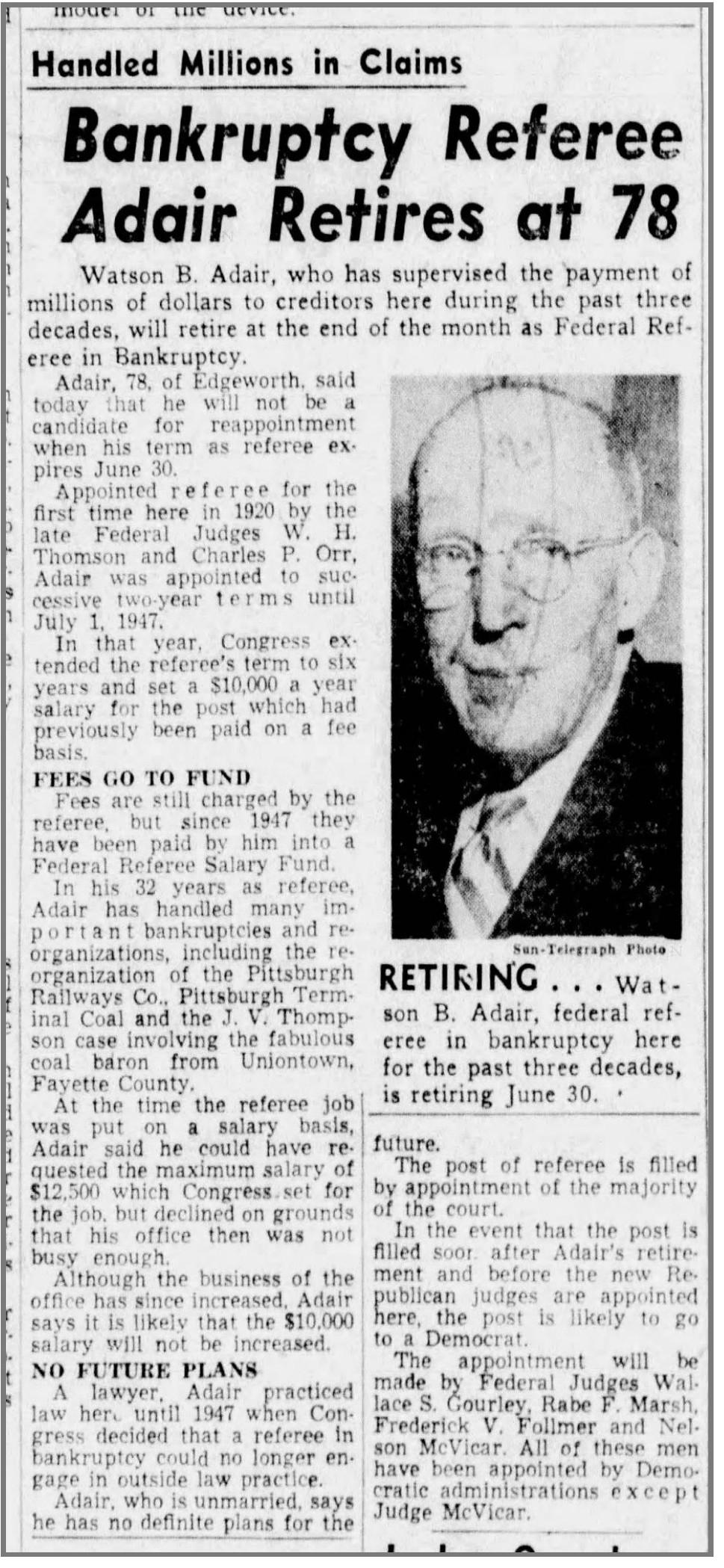
Retirement profile of Watson B. Adair.
The Third Circuit Court of Appeals ultimately agreed, effectively piercing the corporate veil and requiring the underliers to participate in the reorganization proceedings notwithstanding protections asserted under Pennsylvania corporate law. As Special Master, Adair helped navigate these unprecedented issues at a formative moment in American insolvency jurisprudence.
The proceedings reflected the broader evolution of bankruptcy law during the Chandler Act era — away from rigid corporate formalism and toward equitable doctrines capable of addressing the realities of interconnected corporate enterprises. In this respect, Adair’s role in the Pittsburgh Railways litigation mirrored his nationally recognized participation in shaping the Chandler Act itself. Both demonstrated his importance in the development of a more sophisticated and modern system of American corporate reorganization.
In many respects, the modern bankruptcy judiciary still reflects the institutional values that emerged during Adair’s era. Professional education, national collaboration, judicial independence, collegiality, and a shared commitment to improving the administration of justice remain central to the mission of the NCBJ today. Those principles did not arise accidentally. They were cultivated deliberately by leaders like Adair who understood that enduring institutions must be consciously built, strengthened, and sustained across generations.
The judicial seat I occupy today traces directly through Watson B. Adair and, before him, to Referee William R. Blair, the first bankruptcy referee appointed in Pittsburgh. In the generations that followed, the seat was occupied by individuals such as Judge Stephen P. Laffey, Judge Gerald K. Gibson, and Judge Bernard Markovitz — jurists whose influence extended well beyond the courthouse and into the broader social and economic fabric of Pittsburgh itself. Each served during periods of profound industrial, financial, and institutional change within Western Pennsylvania, and each helped shape not only the local administration of bankruptcy law, but also the national development of insolvency jurisprudence and the bankruptcy judiciary as an institution.
That lineage represents far more than a ceremonial succession of officeholders. It reflects an unbroken institutional inheritance spanning more than a century of economic transformation, industrial upheaval, and legal evolution within both Pittsburgh and the federal bankruptcy system. Through Adair in particular, the lineage connects the modern bankruptcy judiciary to the formative national development of bankruptcy administration itself. His generation helped transform bankruptcy adjudication from a fragmented and highly localized administrative function into a respected and coordinated federal judicial system grounded in professionalism, education, collegiality, and institutional legitimacy.
In many respects, the values that continue to define the modern bankruptcy court and the National Conference of Bankruptcy Judges today can still be traced directly to the institutional foundations laid by Adair and his contemporaries.