
Judge Joseph Cosetti, Leader in the “Court of Second Chances” and in the NCBJ
By: Hon. Jeffery A. Deller, U.S. Bankruptcy Judge, Western District of Pennsylvania
One does not truly “own” a judicial seat. One occupies it temporarily and serves as its steward for a time. The people who came before leave behind habits, traditions, expectations, and values that continue to shape the institution long after they are gone.
For me, those lessons became deeply personal long before I took the bench. Before and during law school, I served as a deputy clerk in the Bankruptcy Court for the Western District of Pennsylvania. Working in the Clerk’s Office gave me a perspective on the judiciary that very few young lawyers ever receive.
From behind the intake counter, I watched the daily machinery of justice operate in real time. Pleadings arrived. Orders were entered. Cases moved or stalled. Lawyers succeeded brilliantly at times and struggled badly at others. I came to understand quickly that courts are sustained not merely by doctrine or judicial opinions, but by people and systems working together with professionalism and integrity.
It was during those years that I came to know Judge Joseph Cosetti.
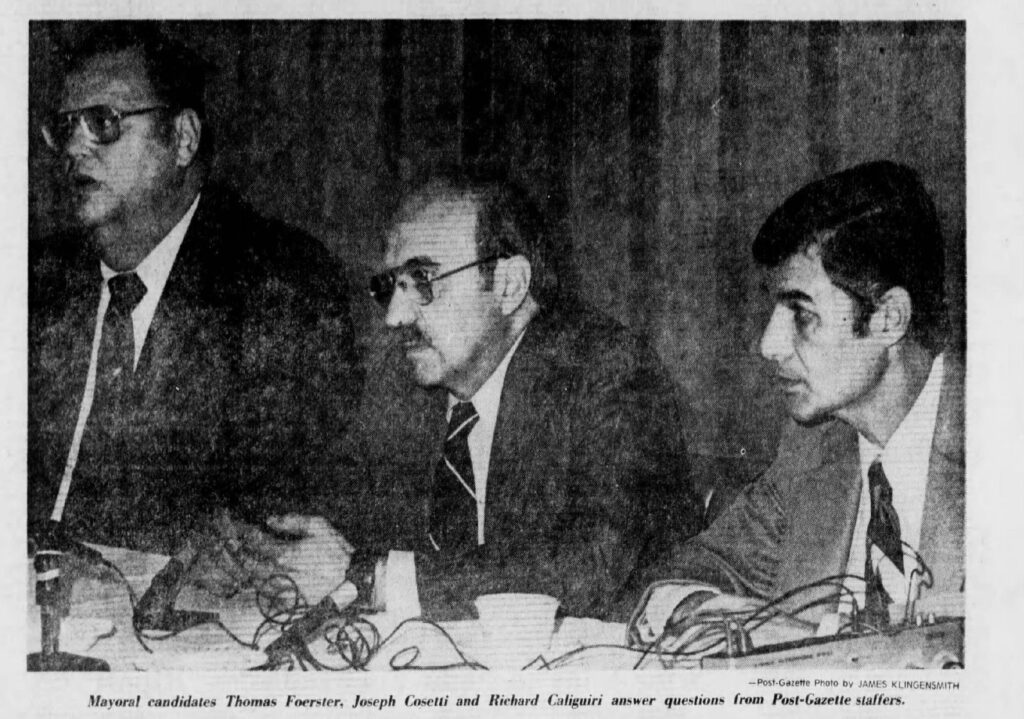
Mayoral debate featuring Joseph Cosetti, Richard Caliguiri, and Thomas Foerster.
Joseph Cosetti was unlike anyone else I encountered in the law. Before ascending to the bankruptcy bench, he had already lived several professional lives: economist, Pittsburgh City Treasurer, political candidate, civic reformer, and public servant deeply immersed in the civic life of the city he loved. He understood not merely law and finance, but also politics, neighborhoods, business realities, and the complexities of human behavior. That broader perspective profoundly shaped both the judge he became and the manner in which he viewed the bankruptcy system itself.
In many respects, Judge Cosetti stood apart from every bankruptcy judge who came before or after him in the Western District of Pennsylvania. A graduate of Duquesne University’s evening law program, he was appointed to the bench only a few years after graduating from law school and possessed relatively little traditional courtroom experience. Yet what he lacked in conventional legal pedigree, he more than compensated for through extraordinary political instinct, intellectual curiosity, and real-world experience. Trained as an economist, Cosetti had served as Pittsburgh’s City Treasurer and became a familiar figure within the city’s political landscape through campaigns for Congress, Mayor, and other public offices. Although he often fell short electorally, those defeats never diminished his stature within Pittsburgh civic life. He remained widely respected, deeply connected, and remarkably resilient.
His public life began to attract statewide attention in 1968, when he was elected as a delegate to the Pennsylvania Constitutional Convention. There, he quickly emerged as a leader within a bipartisan reform coalition advocating modernization of state government. Among those impressed by Cosetti was author James Michener, already nationally renowned for his Pulitzer Prize-winning Tales of the South Pacific. Michener later wrote: “It was a revelation to me to see Joe operate. He has the analytical skill of a social scientist, the imagination of a writer, and the tenacity of a good politician.” That description captured the unique blend of intellect, creativity, and determination that would later define Cosetti’s judicial career.
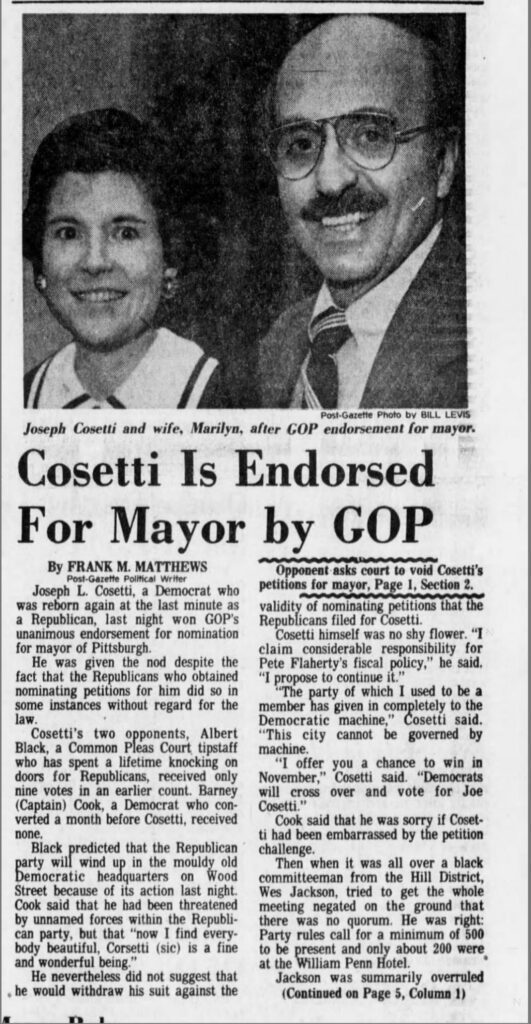
Joseph Cosetti during his mayoral campaign.
Cosetti’s place in Pittsburgh political history became nearly legendary because of the role he played in one of the city’s most consequential mayoral elections. When Mayor Pete Flaherty resigned in 1977 to join the Carter Administration, City Council President Richard Caliguiri became Acting Mayor. The Democratic establishment quickly consolidated behind Allegheny County Commissioner Tom Foerster as its preferred successor. Republican civic leader Elsie Hillman, however, believed Pittsburgh needed Caliguiri’s independence and steadiness more than a return to machine politics. She quietly encouraged Cosetti, a lifelong Democrat, to switch parties and enter the race as a Republican.
The result was one of the most fascinating campaigns in modern Pittsburgh political history. Cosetti instantly became the race’s unpredictable force, moving tirelessly through neighborhoods from Bloomfield to the Hill District, from Lawrenceville to countless fire halls, ward meetings, and community gatherings late into the evening. He shook hands, remembered names, asked about families, and campaigned with relentless energy. Contemporary newspaper accounts described the campaign as quintessentially “Cosetti style”—driven by grit, optimism, personality, and endurance.
Election night unfolded almost exactly as Hillman anticipated. Votes that otherwise may have consolidated behind Foerster fractured, fundamentally altering the political arithmetic of the race. When the final returns were counted, Richard Caliguiri emerged victorious in a narrow but pivotal election that would shape Pittsburgh’s future for years to come. Caliguiri would later become one of the city’s most beloved mayors, guiding Pittsburgh through the painful early years of industrial collapse with humility, steadiness, and grace. Although Cosetti did not win the election, his candidacy altered its trajectory and became part of Pittsburgh political folklore. One contemporary analysis observed that Cosetti had successfully captured the city’s “anti-machine” sentiment at precisely the right moment.
Perhaps most revealing, however, was Cosetti’s own reaction afterward. Rather than lament defeat, he reportedly sat quietly with supporters at a small North Side restaurant, drinking coffee and reflecting simply: “We did what we came to do.” That response revealed much about his character. Public service, for Joe Cosetti, was never primarily about personal advancement. It was about contributing to institutions larger than oneself. That same philosophy deeply informed his approach to bankruptcy law. Judge Cosetti never viewed bankruptcy as merely a technical system of statutes, assets, liabilities, and procedural rules. To him, bankruptcy law was fundamentally about people—individuals and businesses confronting moments of profound uncertainty while searching for stability, survival, and dignity. He frequently described bankruptcy as “a court of second chances,” and he did not use the phrase casually. He genuinely believed the bankruptcy system performed an essential social and economic function within a capitalist society.
He understood that financial collapse often results not from dishonesty or irresponsibility, but from illness, economic downturns, job loss, failed markets, or ordinary human frailty. He rejected simplistic narratives portraying debtors as individuals merely seeking escape from obligations. Instead, he viewed the bankruptcy process as an institution designed both to preserve economic productivity and to protect human dignity.
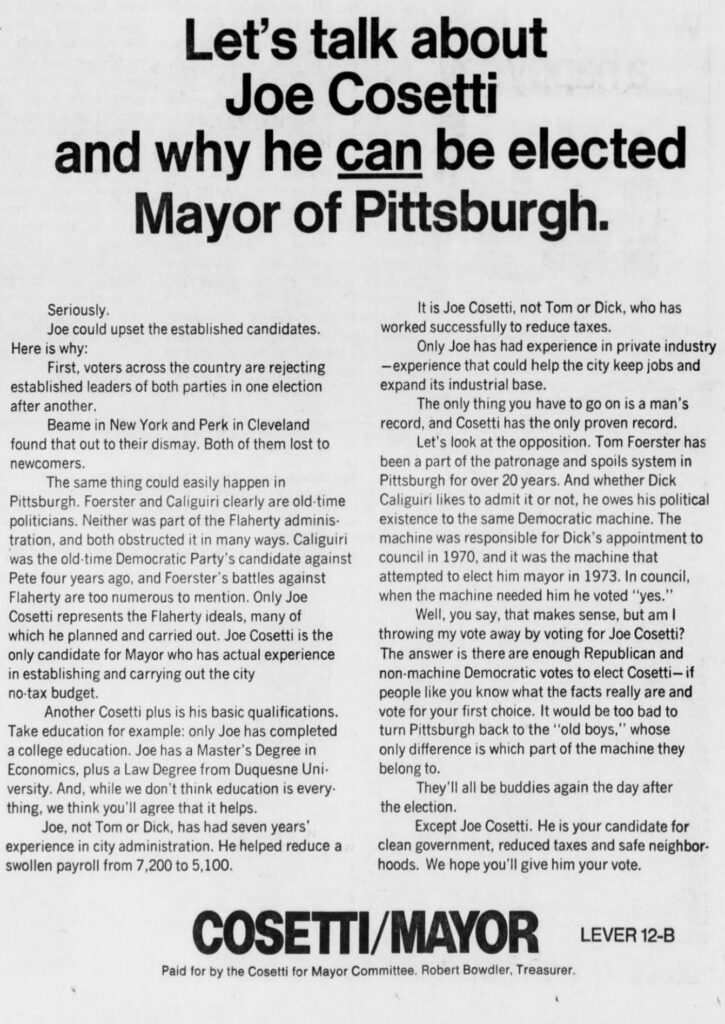
Campaign advertisement from Joseph Cosetti’s mayoral race.
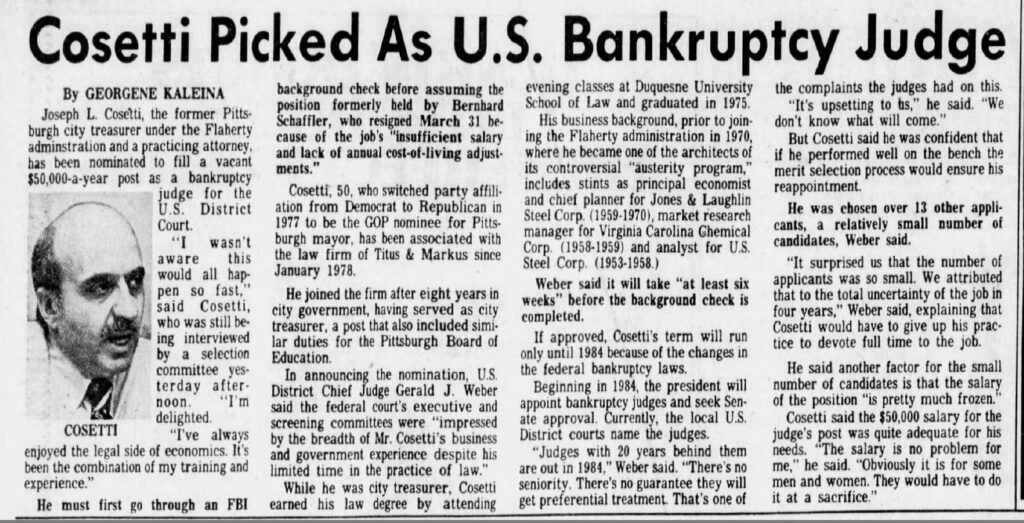
Joseph Cosetti appointed Bankruptcy Judge.
At the same time, Judge Cosetti believed deeply in institutional discipline and professional integrity. Lawyers who practiced before him vividly remember his intensity, his command of detail, and his intolerance for gamesmanship or conduct that threatened the fairness and efficiency of the judicial process. He could be demanding, even intimidating at times, but there was always purpose behind the rigor. His expectations reflected not ego, but a profound respect for the seriousness of the judicial function.
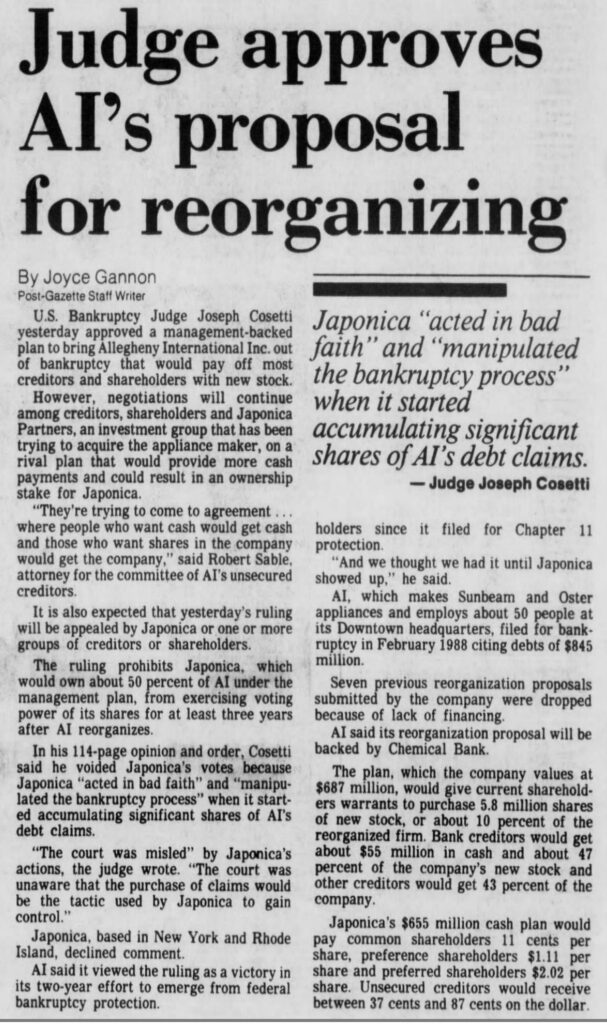
That seriousness became especially evident in large and complex Chapter 11 cases such as Allegheny International. Long before many others fully appreciated the implications, Judge Cosetti recognized the growing significance of distressed debt trading and strategic claims acquisition within modern reorganization practice. He understood that sophisticated financial actors increasingly viewed bankruptcy not merely as a process of rehabilitation, but also as a mechanism for acquiring leverage and shaping corporate outcomes. His willingness to confront those evolving realities reflected both intellectual courage and a deep commitment to preserving the integrity of the bankruptcy system itself.
I had the extraordinary privilege of knowing Judge Cosetti not merely from the courtroom gallery, but from within chambers itself. While attending Duquesne University School of Law at night and working in the Clerk’s Office during the day, I was invited by Judge Cosetti to assist in drafting opinions. That experience permanently transformed my understanding of judging and the judicial process itself.
Law students ordinarily encounter judicial opinions only as polished final products. Inside chambers, however, one witnesses something entirely different. One sees uncertainty, the careful balancing of competing principles, the weighing of facts, and the struggle to reach outcomes that are legally sound while also fair, practical, and humane. Watching Judge Cosetti work taught me that bankruptcy judging requires far more than technical legal analysis. It requires an understanding of economics, business realities, human behavior, and the broader social consequences of judicial decisions. Most importantly, it requires humility, because every case involves people whose lives may be permanently affected by the outcome.
Judge Cosetti’s influence extended far beyond his own courtroom. His oral history for the National Conference of Bankruptcy Judges reveals a jurist deeply committed to institutional stewardship and national judicial collegiality. He often remarked that judges must “plow back” time into the organizations that sustain both the judiciary and the profession itself. That philosophy defined his leadership within the NCBJ.
As President of the NCBJ during 1990–1991, Judge Cosetti helped guide the organization through an especially important period in bankruptcy history. The judiciary was still confronting lingering constitutional uncertainty in the aftermath of Northern Pipeline Construction Co. v. Marathon Pipe Line Co., while simultaneously addressing broader questions concerning the institutional role and legitimacy of bankruptcy judges within the federal judicial system. Caseloads were increasing dramatically, Chapter 11 practice was becoming increasingly sophisticated, and the bankruptcy bench itself was evolving into a far more complex and nationally integrated judiciary.
Judge Cosetti understood that the NCBJ needed to evolve alongside those changes. Under his leadership, the organization increasingly emphasized long-term institutional planning, judicial education, professional administration, and national collegiality designed to strengthen the bankruptcy judiciary across the country. Most importantly, he recognized that the NCBJ served a purpose far greater than simply organizing conferences or annual meetings. It created community. It connected judges who otherwise might feel professionally isolated. It provided younger judges with mentorship, friendship, guidance, and institutional support from colleagues who understood the unique challenges of bankruptcy judging.
That culture of collegiality remains one of the NCBJ’s greatest strengths today. Bankruptcy judges throughout the country continue to exchange ideas, mentor one another, improve educational programming, and collectively strengthen the bankruptcy system through the institutional framework created and sustained by generations of leaders such as Watson Adair and Joseph Cosetti. Judge Cosetti understood that institutions endure only when individuals are willing to invest themselves in something larger than personal accomplishment. In that respect, his legacy extends well beyond the opinions he authored or the cases he decided. It lives on in the culture, professionalism, and humanity of the modern bankruptcy judiciary itself.
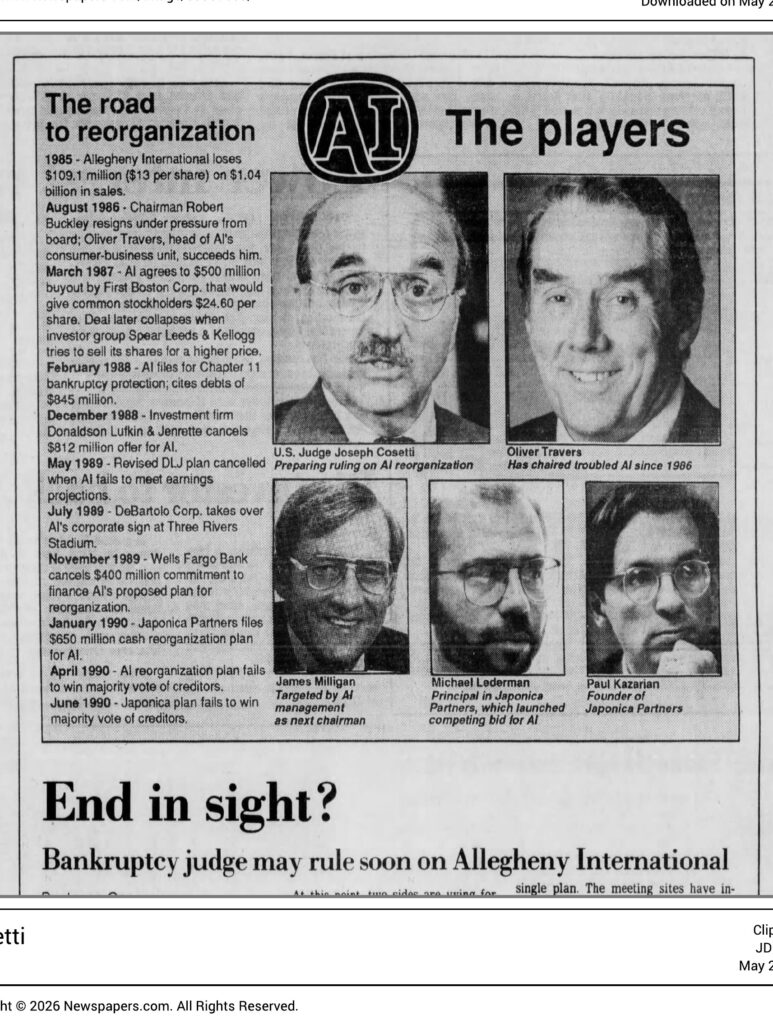
Above (top): Allegheny International reorganization coverage.
Above (bottom): Judge Cosetti’s ruling in the Allegheny International case.