
Judge Judith Fitzgerald, Strengthening the Court and the NCBJ
By: Hon. Jeffery A. Deller, U.S. Bankruptcy Judge, Western District of Pennsylvania
Judge Judith Fitzgerald taught me the importance of institutional excellence, disciplined professionalism, and the long-term stewardship of the judiciary itself. Her influence upon both the bankruptcy system and the National Conference of Bankruptcy Judges was profound.
Judge Fitzgerald was a true trailblazer. She became the first woman appointed to the Bankruptcy Court for the Western District of Pennsylvania and later only the third woman to serve as President of the NCBJ. Yet titles alone do not fully capture her significance. She represented a rising generation of federal judges who approached public service with extraordinary discipline, preparation, and institutional seriousness.
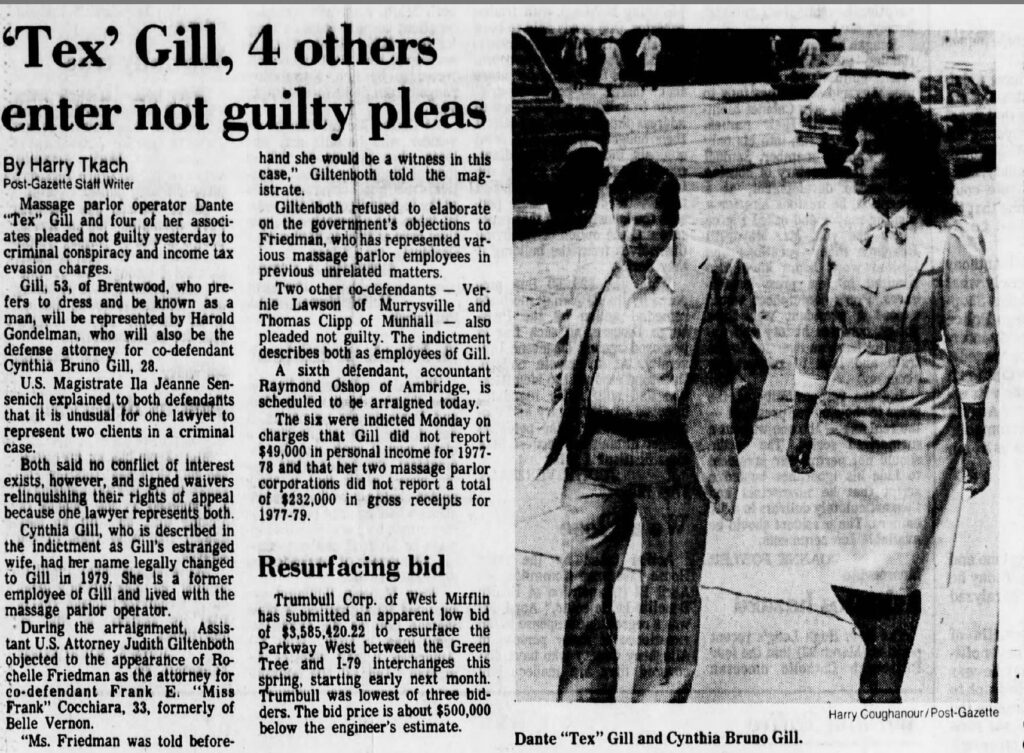
Tex Gill prosecution coverage
Before taking the bench, Judge Fitzgerald served as an Assistant United States Attorney in Pittsburgh, where she prosecuted organized crime, tax fraud, and other complex federal matters during one of the city’s more turbulent eras. Among the most notable prosecutions associated with her tenure was the case involving Dante “Tex” Gill, one of Pittsburgh’s most infamous underworld figures. Gill, born Lois Jean Gill but living publicly as a man decades before such identity was widely understood or accepted, operated a network of massage parlors that served as fronts for prostitution and money laundering. The stories surrounding Gill became part of Pittsburgh legend: tailored suits, cigars, cash hidden in toolboxes and kitchen drawers, political connections, and an atmosphere that often blurred the line between organized crime and political folklore. Yet for Fitzgerald, the prosecution was never about spectacle. It was about discipline, evidence, accounting records, tax ledgers, and the painstaking construction of a case grounded in facts rather than notoriety. Gill was ultimately convicted in 1984, and Fitzgerald carried that same methodical rigor with her to the bankruptcy bench when she was appointed in 1987 at just thirty-nine years old.
Like Cosetti, I first came to know Judge Fitzgerald while serving as a deputy clerk in the Clerk’s Office. That experience allowed me to observe not only her judicial decision-making, but also her remarkable understanding of how courts function institutionally and operationally. At a time when bankruptcy filings and motion practice were expanding dramatically, Judge Fitzgerald recognized that the effective administration of justice depends not only upon sound legal reasoning, but also upon efficient and reliable court systems.
She played a significant role in modernizing the court’s operational practices, including the implementation of procedural innovations such as self-scheduling motion practice, which brought greater order, predictability, and efficiency to increasingly crowded dockets. To outside observers, those reforms may have appeared administrative in nature. In reality, they had enormous practical significance for lawyers, litigants, trustees, clerks, and judges alike. Judge Fitzgerald understood something fundamental about the judiciary: a dysfunctional court cannot administer justice effectively, no matter how intelligent or hardworking its judges may be. Systems matter. Institutional reliability matters. Public confidence depends not only upon substantive fairness, but also upon the consistent and competent functioning of the judicial process itself.
At the same time, Judge Fitzgerald never lost sight of the humanity that must accompany judicial authority. She often spoke warmly of what she learned from Judge Cosetti, particularly his ability to balance firmness with compassion. Reflecting upon his influence, she once remarked:
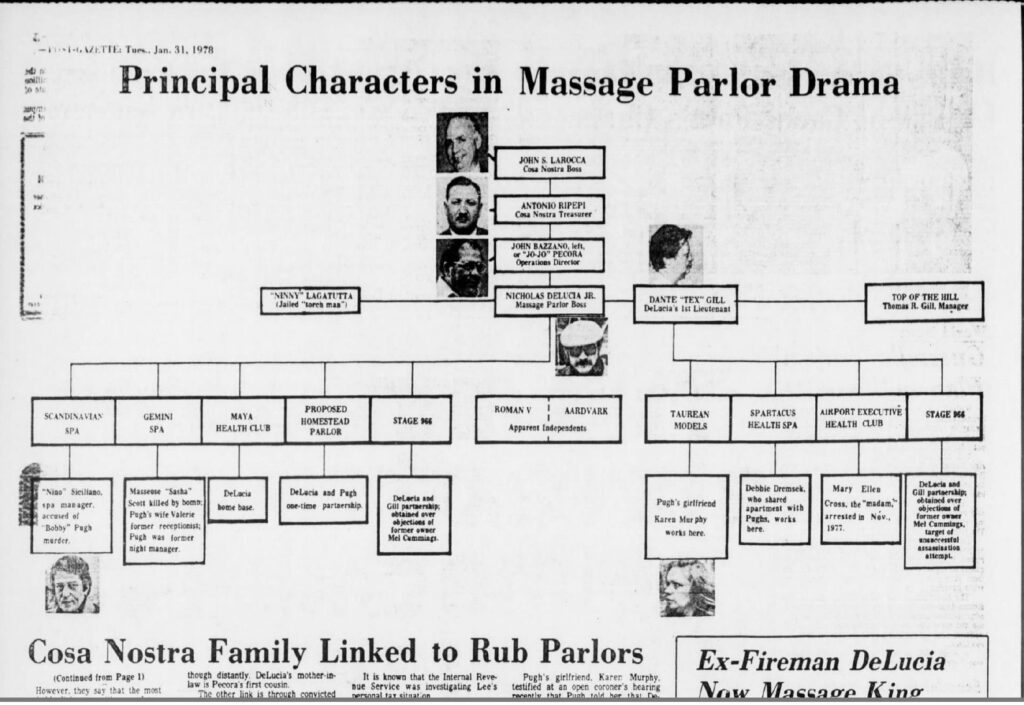
Diagram of alleged organized crime relationships in the Tex Gill investigation.
“From him, I learned that bad news has to be delivered but it can be delivered in a way that shows compassion and assures trust in the fairness of the presiding judge and the bankruptcy system, over all, when judges show their care for the people and institutions that find themselves in dire circumstances. I also learned that a bit of humor can go a long way when times are tough.”
She also fondly recalled one of Judge Cosetti’s favorite observations: “When a debtor files a bankruptcy, he is naked before the world.” For Judge Fitzgerald, that statement captured both the immense fiduciary obligations imposed upon debtors and the equally profound obligation of judges to ensure that all parties remain “on the straight and narrow.”
That same philosophy shaped her leadership within the NCBJ. Judge Fitzgerald viewed the organization not as a platform for personal prominence, but as an institution dedicated to strengthening the bankruptcy judiciary nationally. During her presidency, Congress repeatedly considered sweeping bankruptcy reform legislation that threatened to significantly alter consumer bankruptcy practice while simultaneously increasing burdens upon already strained bankruptcy courts. Fitzgerald responded not with rhetoric or alarmism, but with professionalism, preparation, and institutional steadiness.
Under her leadership, the NCBJ developed contingency educational programming designed to ensure that bankruptcy judges nationwide would be immediately prepared should major reform legislation suddenly become law before the organization’s annual conference. That response reflected one of her defining characteristics: practical institutional leadership grounded in preparation and professionalism. She also worked tirelessly to improve the institutional standing of bankruptcy judges within the broader federal judiciary, advocating for additional judgeships, greater participation by bankruptcy judges within Judicial Conference activities, and reforms designed to strengthen the long-term legitimacy of the bankruptcy bench nationally.
Most importantly, however, Judge Fitzgerald embodied the collegial spirit that remains central to the NCBJ today. She rejected the notion that the Conference revolved around personalities or individual presidencies. Instead, she viewed it as a collaborative institution sustained through continuity, mentorship, shared purpose, and collective stewardship.
She once explained that her dedication to the NCBJ centered upon preserving the organization’s long-term institutional health while ensuring that it continued to provide the highest quality judicial education possible. She reflected: “My dedication to the NCBJ has always been to keep the organization solvent (something that, when I first became Treasurer, was not a given) and to provide the best educational opportunities money can buy while at the same time understanding that bankruptcy, in many ways, is a joint venture among all the stakeholders.”
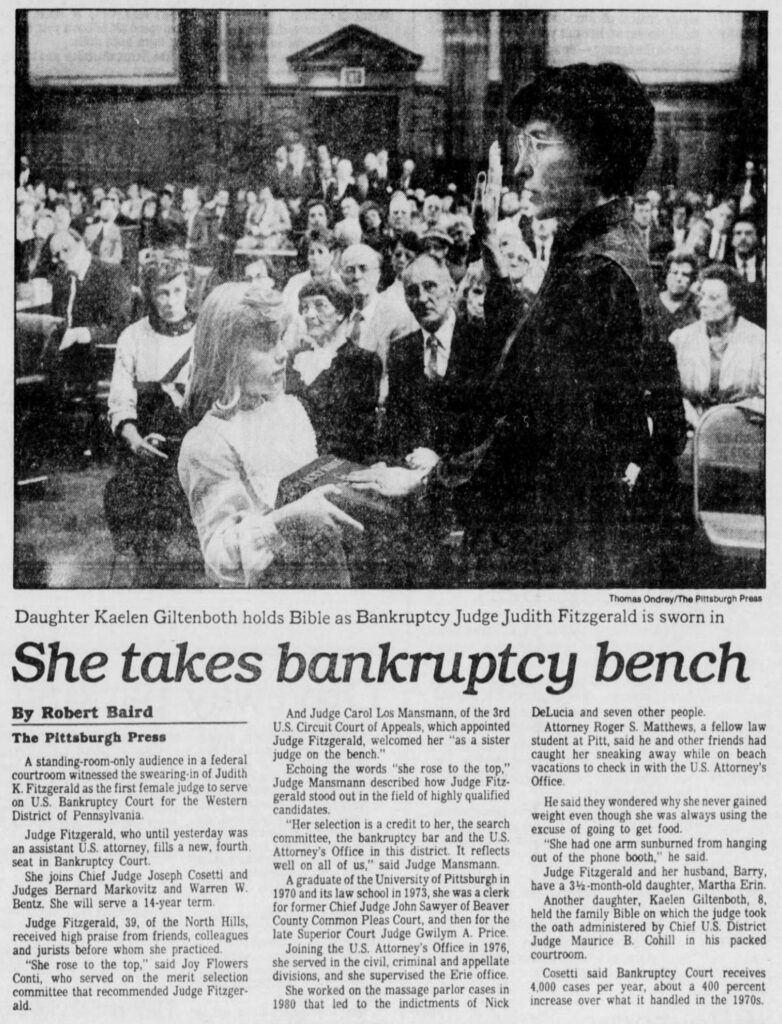
Fitzgerald sworn in as Bankruptcy Judge.
She further observed that, as Judge Bernard Markovitz often reminded her, bankruptcy judges “hold the power of the pen,” but that the exercise of such authority carries enormous responsibility. For Judge Fitzgerald, the ability of judges to exchange ideas, mentor one another, and engage constructively with practitioners was not merely beneficial—it was essential to maintaining the integrity and effectiveness of the bankruptcy system itself. That belief ultimately helped inspire her development of the NCBJ’s “NextGen” initiative, designed to perpetuate the collegiality and mentorship she viewed as indispensable to the profession. Her philosophy profoundly influenced my own understanding of judicial service and institutional responsibility.
Over time, I came to appreciate even more deeply the importance of the NCBJ itself through my own service on its Board of Governors and previously as Editor-in-Chief of the American Bankruptcy Law Journal, the Conference’s flagship academic publication. Those experiences reinforced for me that the NCBJ is far more than a professional association. It is one of the principal institutional stewards of the bankruptcy system in the United States. It preserves institutional memory, advances judicial education, fosters collegiality, and strengthens the administration of justice nationally.
Taken together, Watson Adair, Joseph Cosetti, and Judith Fitzgerald represent three generations in the evolution of both the bankruptcy judiciary and the NCBJ itself. Each shaped the institution at a critical moment in its development. Adair helped build the institutional foundation during the formative years of the national bankruptcy judiciary. Cosetti preserved its humanity while strengthening its legitimacy during a period of constitutional uncertainty and rapid growth. Fitzgerald modernized and professionalized it for an era of increasing complexity and national significance.
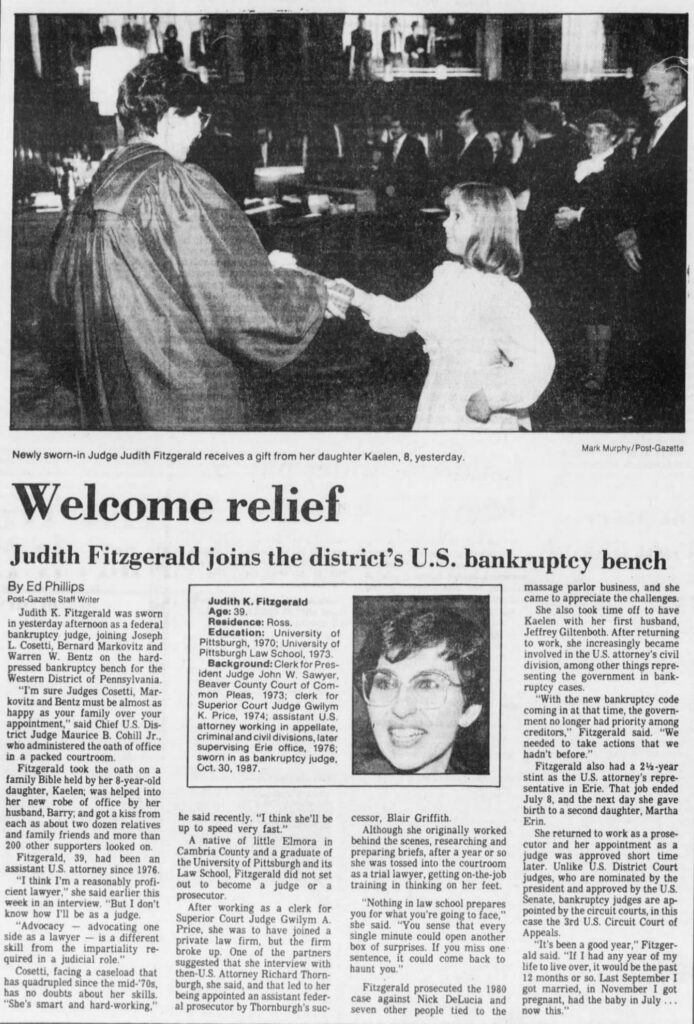
Fitzgerald sworn in as Bankruptcy Judge.
Each understood that the bankruptcy system depends not merely upon statutes or judicial opinions, but upon institutions strong enough to sustain public confidence during moments of financial distress and economic uncertainty. Each recognized that bankruptcy judges owe obligations not only to the law itself, but also to the people and communities the system ultimately serves.
For me personally, their influence has never been abstract or merely historical. I worked in the very court where Cosetti and Fitzgerald served. I learned from them directly. And I now occupy the judicial seat whose lineage traces back through Watson Adair himself. That connection carries both privilege and responsibility. It serves as a daily reminder that judicial service is never entirely individual and that every generation inherits obligations from those who came before it.
That understanding may ultimately be the greatest legacy left behind by Adair, Cosetti, and Fitzgerald. Each understood that institutions endure only if individuals devote themselves not merely to personal achievement, but to preserving and strengthening the system itself for those who follow. Their influence continues to live within the NCBJ, within the bankruptcy judiciary, and within all of us fortunate enough to carry that institutional inheritance forward.